
What Is Usability?
Usability describes how well specific users can achieve specific goals in a specific context of use. Its key criteria are effectiveness, efficiency and satisfaction; it is not an abstract property of a product alone.
Definition (ISO 9241-11)
Usability is the extent to which a product can be used by specific users in a specific context of use in order to achieve defined goals effectively, efficiently and satisfactorily.
Usability is a key quality feature of interactive systems. It describes how well a user can interact with a product in order to achieve their goals - without unnecessary hurdles or frustration.
Evaluation therefore considers the intended users, their goals and the context of use, such as device, environment, time pressure and available support. The same application may work well for experienced staff at a desk but poorly for first-time users on a small screen under time pressure.
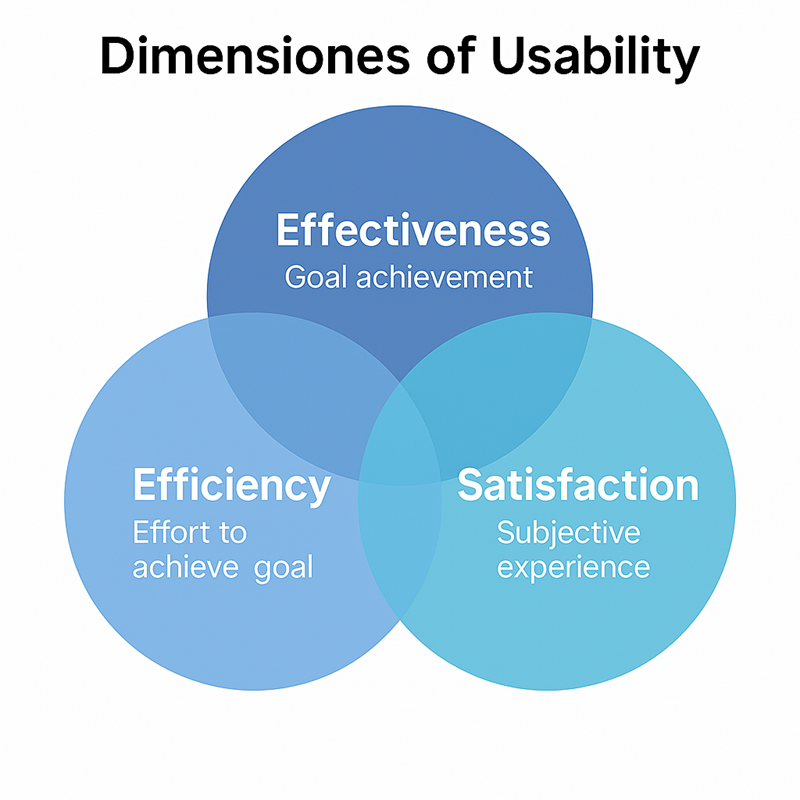
The three dimensions of usability
1. Effectiveness
The extent to which users achieve their goals completely and correctly.
Example: Is an online form filled out and sent correctly?
2. Efficiency
Effort in relation to target achievement.
Example: How many steps, clicks or thought processes does a user need to complete a task?
3. Satisfaction
Subjective experience during use (e.g. confidence, enjoyment, freedom from stress).
Example: How pleasant does a user find the operation of an app?
Usability ≠ User Experience (UX)
Usability is a sub-area of the more comprehensive User Experience (UX).
| Usability | User Experience |
|---|---|
| Focus on task fulfillment | Focus on holistic experience |
| Focused on efficiency, freedom from errors | Including emotion, trust, brand perception |
| Short-term use | Also before and after use |
Why is Usability Important?
- Economical: Good usability reduces support costs and increases conversions.
- Psychological: It promotes cognitive relief, motivation and trust.
- Ethical: It prevents frustration, errors and potential risks of use.
- Normative: It is part of many standards (e.g. ISO 9241, EN 301 549).
Conclusion
Usability asks whether people can achieve specific goals effectively, efficiently and satisfactorily. User experience also covers perceptions and responses before, during and after use, including expectations, emotions, trust and context. Completing a task smoothly is an important part of UX, but does not describe the whole experience.
Relevant ISO standards
- ISO 9241-11:2018 defines usability through effectiveness, efficiency and satisfaction in a specified context of use.
- ISO 9241-110 describes dialogue principles for the design of interactive systems.
- ISO 9241-210 addresses the human-centred design process for interactive systems.
These standards complement one another: ISO 9241-11 helps describe and evaluate usability, while the other parts inform design and development processes.
Conclusion
Usability is more than just “ease of use” - it is a measurable, designable characteristic of interactive systems that directly influences the achievement of objectives, workload and user satisfaction.
It is a prerequisite for good UX - but not the same as it.
Further Reading
Frequently asked questions (FAQ)
What does usability mean?
Which three criteria define usability?
How is usability different from UX?
Why is usability important?
How can you measure usability?
Is usability regulated by standards?
Are there alternative spellings?
Last modified: 14 October 2026